Pierre Valremy
The Day of the JackalPierre Valremy is a CRS recruit whose first assignment in the capital appears to be another tedious post on a barrier. When a disguised gunman later draws him into the pursuit, his ordinary duty becomes a fatal encounter with the Jackal.
Identity and Background
Valremy had joined the CRS after losing his factory job in Rouen. At the Labour Exchange, a recruitment poster had promised a future and an interesting life, presenting uniformed service as a sharp contrast to redundancy. The reality was less polished: the barracks felt like a prison, and the routine brought drill, night exercises, an itchy serge blouse, and long waits in bitter cold or blazing heat. The arrests he was made to anticipate never came; the people whose papers he checked were generally conducting harmless business. Valremy had begun to regret enlisting, and the unvarying duties had made the work feel like a route to drink rather than adventure.
His first trip beyond Rouen offered no escape from that routine. Under Sergeant Barbichet’s command, he was posted to a crowd barrier and told to keep it in place and admit no one without authorization. The assignment was described as responsible, but its immediate demands were simply to watch the barrier and wait. For Valremy, even a major public occasion brought another stretch of standing guard rather than the interesting life the poster had implied.
Liberation Day and the Veteran at the Barrier
The post that seemed to promise nothing became a small crossing point in a much larger security operation. For the Liberation Day ceremony, reinforcements had been brought into Paris from the provinces, and the barriers formed a chain across Rue de Rennes. Valremy’s section stood roughly two hundred and fifty metres from Place du 18 Juin 1940; beyond the square lay the station forecourt, where officials were marking out positions for the veterans and the Garde Républicaine band. With three hours still to wait, Valremy watched the first spectators gather in the heat. He knew they had come to glimpse Charles de Gaulle from a distance, and he treated the crowd’s patience as another curious feature of an otherwise tedious assignment.
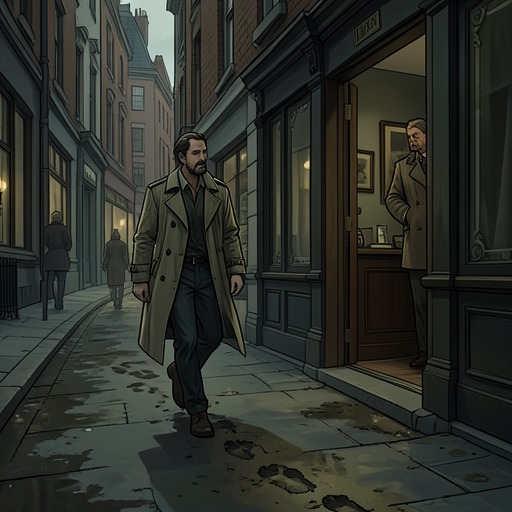
Among the people approaching the barrier, an old man drew his attention. He moved slowly, leaning on an aluminium crutch, wearing a sweat-stained black beret and a long greatcoat, with medals hanging and clinking on his chest. Valremy’s thoughts reduced the stranger to the marks of age and injury: a man who had lost a leg, and whose medals might be all that remained to him. The narrative lets the guard’s impatient, dismissive outlook frame the encounter before the old man even reaches him. When the veteran timidly asked to pass, Valremy requested his papers.
The man produced two cards identifying him as André Martin, a fifty-three-year-old French citizen born in Colmar and resident in Paris. One card described him as a war invalid. Valremy checked the photographs against the face before him and asked him to remove his beret; the veteran complied, and the guard judged the likeness genuine. The old man’s grey, sweaty face, unkempt hair, and small shaving cuts completed the convincing appearance. In this brief inspection, ordinary identity checks seem to settle the question: the cards match the person, and the person matches the image of a pensioner returning home.
Martin said he lived nearby, retired on a pension, in an attic. Valremy checked the address, 154 Rue de Rennes, against the building beside him, numbered 132, and concluded that the stated address must be farther down the street. There was no order against letting an old man go home. He waved Martin through, warning him not to get into mischief because Charles de Gaulle would be coming along in a couple of hours. The veteran replied that an old comrade was to receive a medal; he had received his own two years earlier, but only from the Minister of the Armed Forces. As he put away his cards, he nearly stumbled, and Valremy reached out to steady him. The small act of assistance accompanies the decisive mistake: the guard lets the disguised Jackal pass the barrier and toward the ceremony.
The Pursuit and His Death
The ceremony transformed Valremy’s routine post into the emergency he had never expected to face. As the medal presentation began in the station forecourt, Claude Lebel reached the barrier and identified the doorway through which the old veteran had entered. Valremy followed him inside, glad to leave the conspicuous disorder of the street, where their hurried movement drew disapproving looks from officers standing at attention. At first he thought the small detective might be in trouble for pretending to be a police commissaire; then he understood that Lebel was genuine and that they were pursuing a criminal. The realization brought no triumph: Valremy wished he were back in barracks.
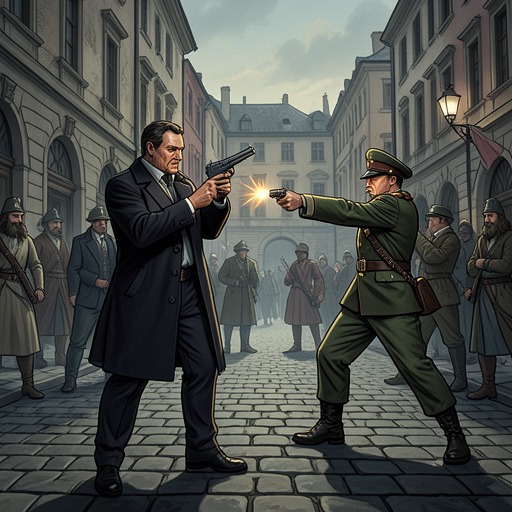
Lebel ran upstairs, calling out that the suspect was on the top floor, and Valremy pounded after him, unslinging his carbine. Six floors up, Lebel paused before two doors. A faint sound came from behind one of them, and he ordered Valremy to shoot off the lock. Valremy braced himself and fired. The door buckled inward, and he entered the room first, recognizing the grey tufts of hair—but now the supposed veteran had two legs, no greatcoat, and the strong arms of a young man gripping a rifle. The Jackal fired from the hip before Valremy could act. The rifle’s bullet tore into Valremy’s chest and exploded; as his senses failed, his last remembered image returned to the one-legged old gull he had recalled while watching the disguised gunman approach.
Valremy’s death is the cost of the mistake that began as an unremarkable act of discretion. He had checked the papers, compared the photographs, accepted the address, and reached out to steady the man he believed was an elderly veteran; none of those ordinary safeguards exposed the disguise. The earlier image of the injured gull returns at the moment of death, linking his passing to the way he had first judged the stranger by his missing leg. The Jackal’s disguise turns Valremy’s routine humanity and routine procedure alike against him.
Narrative Function and Final Perspective
Valremy’s part in the climax is defined by how little of the larger crisis he can see. From his barrier on Rue de Rennes, the Liberation Day ceremony is a distant spectacle and the security rumors are, by habit, easy to dismiss. The narrative then cuts between the public ritual—Charles de Gaulle pinning a medal on a veteran—and the pursuit inside the building. While the President continues the ceremony, Valremy follows Claude Lebel upstairs, unaware that the disguise he admitted through the barrier has already brought the gunman within firing distance.
His death marks the point at which the ordinary guard’s post gives way to the direct confrontation between Lebel and the Jackal. Valremy enters first after forcing the door, and the Jackal shoots him before he can respond; Lebel then faces the gunman alone. The ceremony and the pursuit thus converge without Valremy ever reaching the public event he had been assigned to protect. His brief, limited viewpoint makes the danger legible not as an abstract security failure but as a chain of routine decisions, followed by a sudden violence that ends his part in the story.